
Table of Contents
A chatbot and live chat look the same on a website, but they solve different problems. A chatbot answers automatically from a knowledge base. It works best for repeat questions, busy periods, and service outside office hours. In live chat the reply comes from a person, so it is better for negotiation, complaints, emotionally charged situations, and demanding expert questions. For most companies the most practical model is a chatbot first, with a person behind it when needed. Aihio is built around that idea: the chatbot answers when the information exists and routes the customer onward when human judgement is needed. Base your choice on the questions your customers ask, not on the name of the tool. If a question is simple and the answer lives in a document, a chatbot is usually enough. If it requires trust or negotiation, a person handles it better. This comparison covers response time, costs, customer experience, typical use cases, and a phased move from live chat to a chatbot-supported model. At the end you get a decision tree for picking your first step. Access is arranged through a demo.
Quick comparison
| AI chatbot | Live chat | |
|---|---|---|
| Response time | Seconds | 2–15 min (longer when busy) |
| Hours | 24/7 | Usually 8–16 on weekdays |
| Cost/month | From €0–39 | Tool + staff time |
| Capacity | Many conversations in parallel | 1–3 chats per agent |
| Complex cases | Routes onward | Solves them |
| Emotional nuance | Limited | Strong |
The chatbot is strongest on volume and round-the-clock availability. Live chat resolves the demanding cases. The best customer service combines both.
When is a chatbot the right pick?
The same questions keep coming back
If your support team answers the same questions every day about opening hours, prices, delivery terms, or returns, a chatbot handles those for you.
A small team can’t staff a chat
In a business of 1–3 people, nobody has time to sit by a live chat. A chatbot answers visitors without tying a single employee to the queue.
Visitors arrive in the evenings, on weekends, and during holidays
If a big share of your visitors come outside office hours (common for e-commerce), live chat isn’t answering then. A chatbot still is.
Consistent answers matter
A chatbot gives the same answer to the same question every time. A person can forget, guess, or phrase things differently depending on who is on shift. Consistency matters most in regulated industries such as finance, healthcare, and the public sector.
When is live chat the better pick?
Negotiation and customisation
If sales rely on negotiation (B2B solutions, custom projects, large orders), a person reads nuance and the negotiating situation better than a chatbot.
Emotions are running high
Complaints, frustrated customers, and escalations need empathy. A chatbot can notice that a conversation has turned sour and call in a person. The resolution still has to come from a human.
The product demands deep expertise
Some fields (HVAC renovations, legal services, specialised B2B software) are hard to cover even with a large knowledge base. If every customer question is unique, live chat is often the more natural fit.
The combination: chatbot + live chat
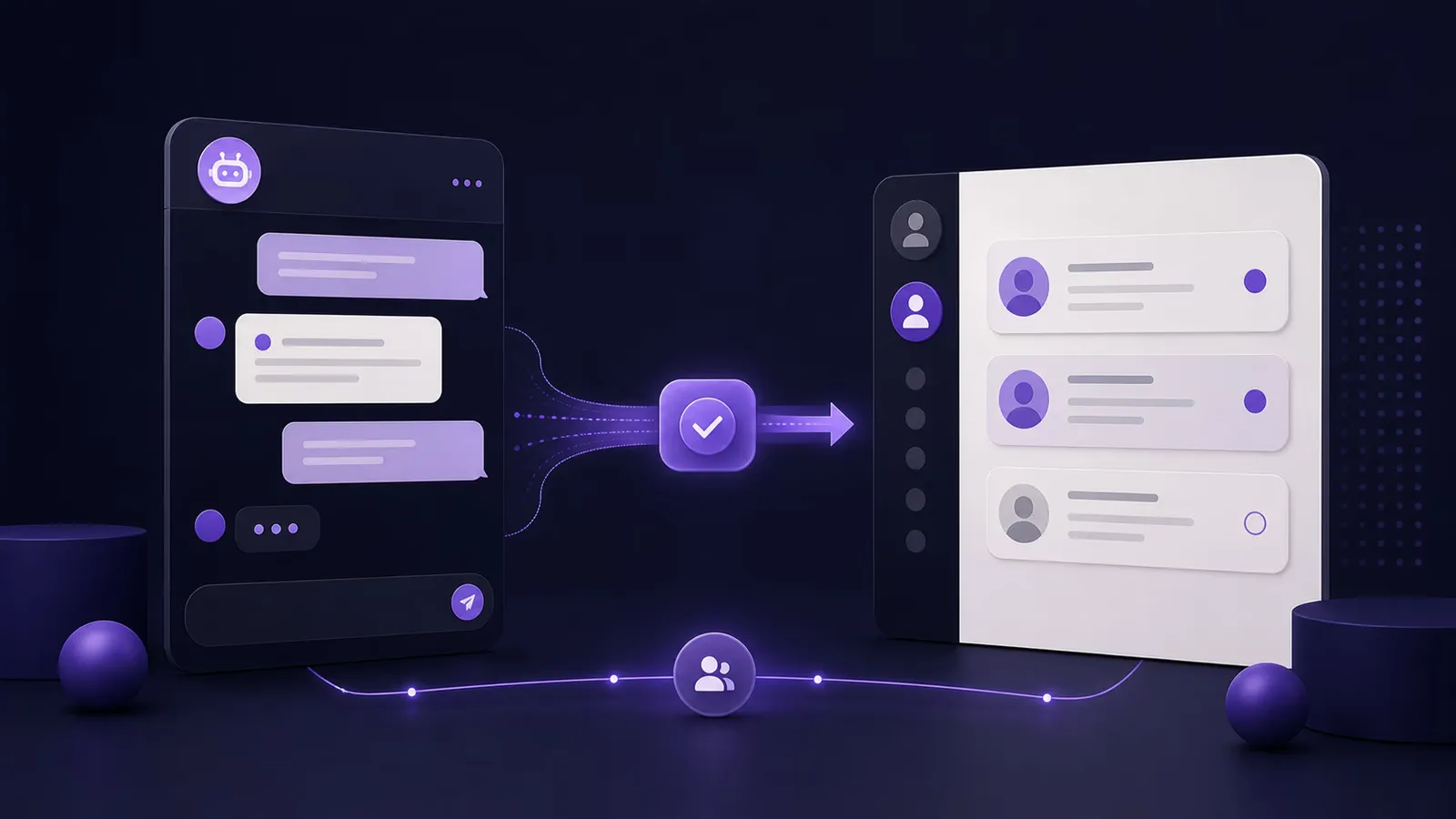
For most businesses the best model is chatbot first, human behind it. In practice it works like this:
- A customer opens the chat widget. The chatbot greets them and asks what they need help with.
- The chatbot tries to answer from the knowledge base.
- If it can’t answer, or the customer asks for a person, the conversation moves to the live chat queue.
- The agent sees the earlier conversation, so the customer never has to repeat themselves.
What the combination gives you
Support workload can drop. The chatbot handles a share of the repeat questions, so agents more often see only the cases that genuinely need a human.
Live chat response time improves too. With no simple cases sitting in the queue, agents get to the demanding ones faster.
Customers get to choose. Those who want a person reach the queue quickly. Those who just want a quick fact get it without waiting.
Cost comparison in practice
Take an e-commerce store that gets hundreds of chat conversations a month. The exact costs depend on salary levels, the tool, and how many conversations need a person.
Live chat only
- Agent time has to be reserved for staffing the chat
- The live chat tool is usually billed monthly or per user
- The biggest cost isn’t the tool but keeping a person on the line
- Response time: 5–20 min
- Service hours: weekdays 8–16
Chatbot + live chat combo
- Aihio Starter starts at €39 per month
- The chatbot answers repeat questions first
- A person spends time only on conversations the chatbot can’t handle
- Response time: seconds (chatbot) + 2–5 min (human during peaks)
- Service hours: 24/7
The cost advantage grows with volume. The outcome still depends on how many of your questions are genuinely repetitive and answerable from a knowledge base.
Decision tree: which one should you start with?
Work through this table before picking a tool:
| Situation | Start here |
|---|---|
| More than half of the questions repeat | Chatbot |
| Questions require negotiation or case-by-case judgement | Live chat |
| Buyers visit the site in the evenings and on weekends | Chatbot |
| Customers are often angry or worried | Live chat, chatbot for routing only |
| The team is small and can’t staff a chat | Chatbot + contact routing |
| Sales are high-value B2B negotiation | Live chat or a sales form, with a chatbot for basic questions |
If you’re not sure, start with the chatbot in a limited way: show it only on certain pages or outside office hours. That way you gather evidence without changing your whole support model at once.
Moving from live chat to a chatbot
If you run live chat today and are considering adding a chatbot, don’t switch everything at once. A phased move works better:
Analyse your current conversations
List the last 200 chat conversations. Tag them “routine”, “complex”, “complaint”. If routine is over half, a chatbot fits well.
Start the chatbot during off-hours
Show the chatbot only in the evenings and on weekends, when no agents are online. That way you test the chatbot’s quality without it competing with a human.
Expand to full hours
Once the resolution rate, meaning the share of conversations resolved without a human, has settled above 60 %, extend visibility to all hours. The agent handles only the demanding cases.
Measure the impact
Watch two metrics: customer satisfaction (CSAT) and the change in agent workload. Both should move in the right direction within three months.
Frequently asked questions
Can I run a chatbot without live chat?
Yes, and many small businesses do exactly that. The chatbot provides an escalation path: if it can’t answer, it points the customer to email or a contact form, or gives them a phone number. That’s cheaper than staffing live chat, and the customer still reaches a person when needed.
Do customers hate chatbots?
Customers hate bad chatbots. A good chatbot knows its limits, answers questions covered by the knowledge base fast, and offers a human when one is needed. On routine matters, customers value speed over human contact.
How do I know when to swap a chatbot for live chat?
When the resolution rate stays below 60 % for an extended period, or customer satisfaction drops. That can mean the knowledge base needs updating, or that your product or service has grown complex enough that a chatbot alone isn’t enough.
Can I connect Aihio to my existing live chat tool?
Yes. Aihio routes the customer to the contact channel you choose, including an external tool. For deeper integrations, check the current integration options or ask sales before deciding.
Takeaway
Chatbot and live chat complement each other. The chatbot brings availability and handles the repeat questions; live chat handles empathy and the complex cases. For a small business, a chatbot with email escalation is often enough. For a larger business, the combination can lighten the support workload.