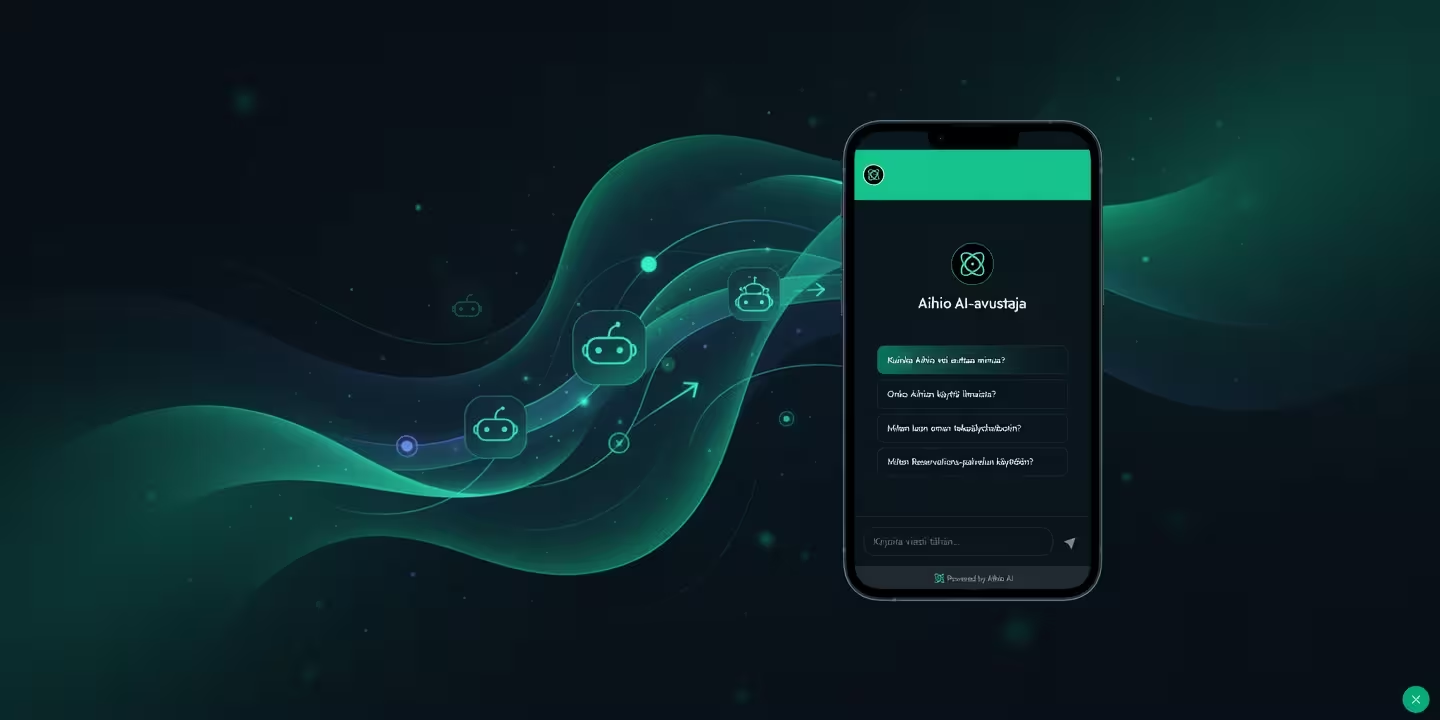

A chatbot and live chat solve different problems, even though they look similar on a website. A chatbot answers automatically from a knowledge base and works best for repeat questions, busy periods, and service outside office hours. Live chat is answered by a person, so it is better for negotiation, complaints, sensitive cases, and expert judgement. For most companies the best model is not either-or, but chatbot first and a person behind it when needed. Aihio supports that model: the chatbot answers when the information is available and routes the customer onward when human judgement is needed. A free test is enough to see whether some questions can be handled automatically before expanding live chat. This comparison covers response time, cost, customer experience, use cases, and a practical decision tree for choosing the first step.
Quick comparison
| AI chatbot | Live chat | |
|---|---|---|
| Response time | Seconds | 2–15 min (longer when busy) |
| Hours | 24/7 | Usually 8–16 on weekdays |
| Cost/month | 0–200 € | 50 €/agent + salary |
| Capacity | Many conversations in parallel | 1–3 chats per agent |
| Complex cases | Hands off | Solves them |
| Emotional nuance | Limited | Strong |
The short version: the chatbot wins on volume and availability, live chat wins on resolving the hard stuff. Sites that run both well combine them.
When is a chatbot the right pick?
Repeat questions
If your support team answers the same questions every day (opening hours, prices, delivery terms, return policies), the chatbot handles those efficiently.
Small teams don’t have capacity for live chat
A business with 1–3 people usually can’t staff a live chat. The chatbot provides “someone to talk to” without tying up a specific person.
A lot of evening, weekend, and holiday traffic
If a big share of your traffic comes in the evening or on weekends (common for e-commerce), live chat isn’t answering then. The chatbot is still there.
Consistency matters
The chatbot gives the same answer to the same question every time. A human can forget, guess, or phrase things differently. Consistency matters most in regulated industries (finance, healthcare, public sector).
When is live chat the better pick?
Negotiation or customisation
If sales rely on negotiation (B2B solutions, custom projects, large orders), a human reads nuance and negotiating tactics better than any chatbot.
Emotionally charged situations
Complaints, frustrated customers, service failures: these need empathy. The chatbot can notice when a conversation has gone sideways and hand off, but the resolution has to come from a person.
Very technical product expertise
Some categories (HVAC renovations, legal services, specialised B2B software) are hard to cover even with a big knowledge base. If every question is unique, live chat is often a better fit.
The combination: chatbot + live chat
The best setup for most businesses is chatbot first, human behind it. Like this:
- A customer opens the chat window. The chatbot says hello and asks what they need.
- The chatbot tries to answer from the knowledge base.
- If it can’t, or if the customer clearly asks for a person, the conversation moves to the live chat queue.
- The live-chat agent sees the earlier conversation, so the customer doesn’t have to repeat anything.
What you gain
Agent workload can drop significantly. The chatbot handles the bulk of repeat questions. Agents see only the cases that actually need them.
Live-chat response time improves too. Without simple cases clogging the queue, agents get back to the harder ones faster.
Customers get a choice. Those who want a person jump the queue quickly. Those who just want a quick fact get it in 10 seconds.
Cost comparison in practice
Take an e-commerce store that gets 500 chat conversations a month:
Live chat only
- 1 part-time support agent (20 h/week): ~1 800 €/month with overheads
- Live-chat tool: often from 50–100 €/month before staffing costs
- Total: ~1,900 €/month
- Response time: 5–20 min
- Covers Mon–Fri 8–16
Chatbot + live chat combo
- Aihio Starter: 39 €/month for the first automation layer
- Live-chat or support tool in parallel: often from 50–100 €/month
- Less agent time spent on repeat questions
- Total: depends on staffing, but routine volume becomes cheaper to handle
- Response time: seconds (chatbot) + 2–5 min (human during peaks)
- Covers 24/7
The cost gap widens with volume. 1 000+ conversations a month makes the combo clearly cheaper.
Moving from live chat to a chatbot
If you’re on live chat now and thinking about adding a chatbot, don’t switch overnight. A phased rollout works better:
Analyse your current conversations
List the last 200 chats. Tag them “routine”, “complex”, “complaint”. If routine is over half, the chatbot fits well.
Start the chatbot during off-hours
Show the chatbot only in the evenings and on weekends, when no agents are online. That way you test the chatbot’s quality without it competing with a human.
Expand to full hours
Once the chatbot reliably answers the main repeat questions, extend visibility to all hours. The agent steps in only for the hard cases.
Measure the impact
Watch two metrics: customer satisfaction (CSAT) and agent workload change. Both should move in the right direction within three months.
Frequently asked questions
Can I run a chatbot without live chat?
Yes, and many small businesses do. The chatbot provides an escalation path. If it can’t answer, it points the customer to email, a contact form, or a phone number. That’s cheaper than staffing live chat, and the customer still gets human contact when needed.
Do customers hate chatbots?
Customers hate bad chatbots. A good chatbot is clear about its limits, answers fast from the knowledge base, and offers a human when needed. Customers value speed over human contact on routine questions.
How do I know when to swap a chatbot for live chat?
When the resolution rate drops below 60 % for a while, or when CSAT drops. That can signal the knowledge base needs updating, or that your product/service has grown complex enough that the chatbot alone isn’t enough.
Can I connect Aihio to my existing live-chat tool?
Aihio can guide the customer to the right next step, such as email, a contact form, phone support, or an existing support tool. For deep two-way integrations, check the current integration options before rollout.
Takeaway
Chatbot and live chat aren’t alternatives. They complement each other. The chatbot handles volume and availability. Live chat handles empathy and the tough cases. For a small business, the combo may be overkill; a chatbot with email escalation is enough. For a larger business, the combination saves significant agent workload.
Try Aihio for free and see how a chatbot would fit your site.
Related Posts
Back to all posts